Dutasteride (Avodart) vs Proscar (Finasteride) 2026 — Effectiveness, DHT Blockade, Safety & Key Differences
Dutasteride and Proscar (finasteride) are oral medications that treat hair loss and benign prostatic hyperplasia (BPH) by reducing DHT levels. Dutasteride blocks more enzyme types, which may lead to stronger suppression and potentially greater hair retention.
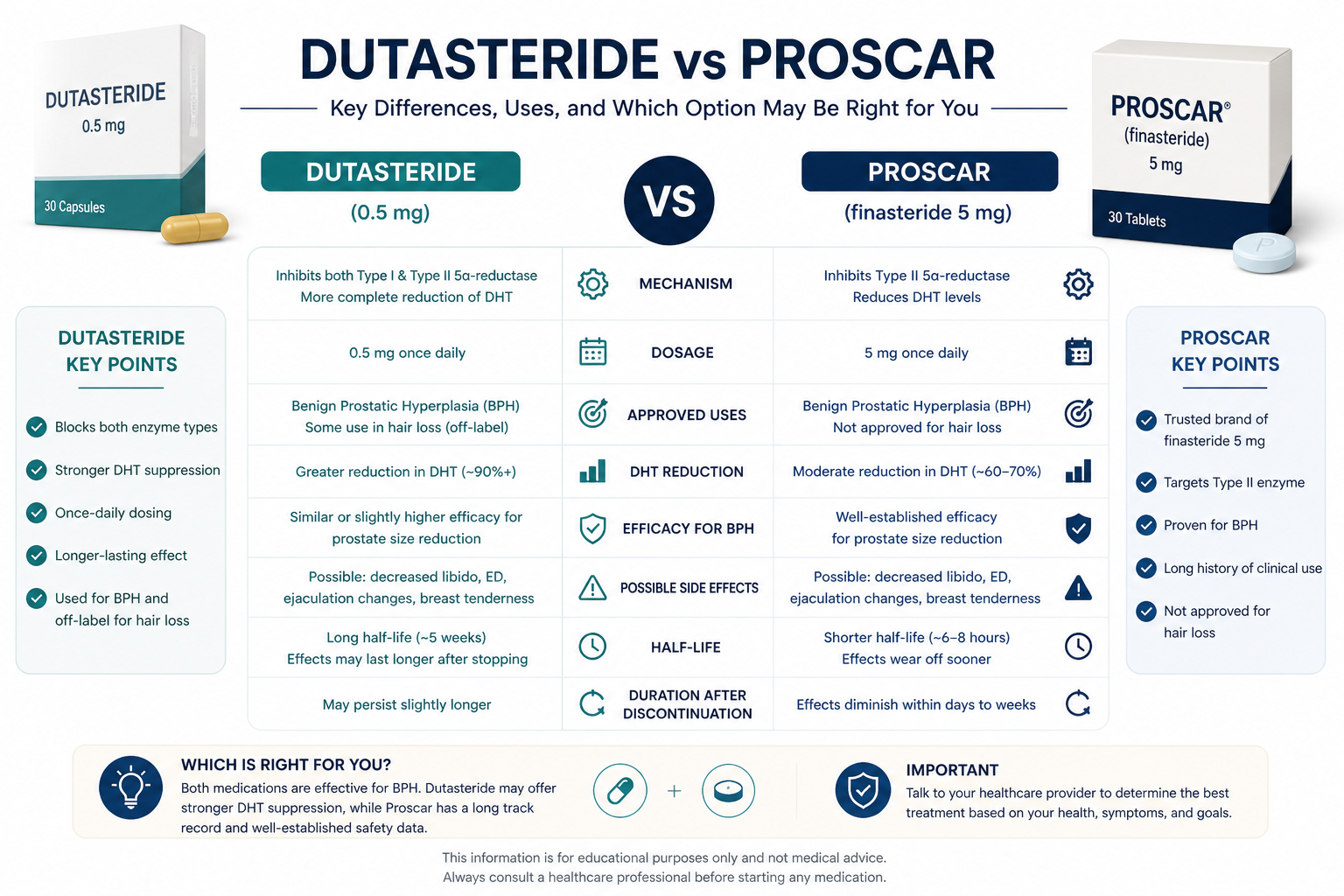
Quick Comparison
| Feature | Dutasteride | Proscar (Finasteride) |
|---|---|---|
| How it Works | Blocks type I & II 5α-reductase enzymes | Blocks type II 5α-reductase enzyme |
| DHT Reduction | ~90%+ | ~60–70% |
| Form | Oral capsule | Oral tablet |
| Best For | Moderate to advanced hair loss / BPH | Mild to moderate hair loss / BPH |
| Time to Results | 3–6 months | 3–6 months |
| Main Side Effects | Sexual side effects (some users) | Sexual side effects (generally lower incidence) |
| Half-Life | Long (~5 weeks) | Short (~6–8 hours) |
When Dutasteride May Be Better
Dutasteride may provide stronger results because it suppresses DHT more completely, which is the primary driver of androgenetic alopecia.
- More potent DHT reduction (~90%+)
- Targets both enzyme types
- Often used when finasteride is not effective enough
- Better for advanced hair loss cases
When Proscar May Be Better
Proscar may be preferred as a first-line treatment due to its long safety record and lower overall hormonal suppression.
- Well-established safety profile
- Shorter half-life (leaves body faster)
- Often first-line therapy
- Effective for many users with mild to moderate hair loss
Can You Use Them Together?
No. Dutasteride and Proscar should not be used together because they belong to the same drug class and work through similar mechanisms.
Using both would not significantly increase effectiveness but may increase the risk of side effects.
Compare Hair Loss Treatment Providers
Review pricing, consultations, and treatment options online.
Compare OffersFAQ
Is dutasteride stronger than Proscar?
Yes. Dutasteride blocks more enzyme types and typically reduces more DHT than finasteride.
Which is better for hair loss?
Dutasteride may be more effective, especially in advanced cases, but Proscar works well for many users.
Which has fewer side effects?
Proscar may have slightly fewer side effects due to lower overall DHT suppression.
Do results reverse after stopping?
Yes. Hair loss typically resumes after discontinuing treatment.
Informational content only. Not medical advice.